

Lahore | ReNews Pakistan
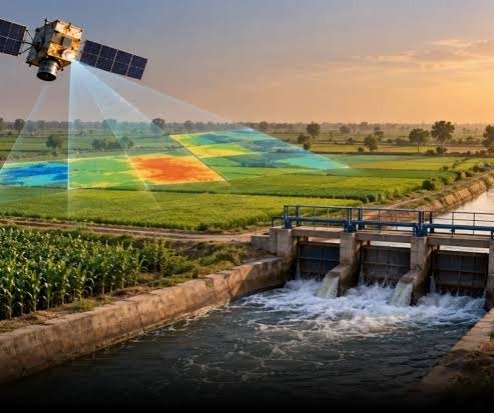
Pakistan has expanded the testing of a satellite based irrigation decision-support system to the canal network serving approximately 13.3 million kanals of agricultural land in Punjab, aiming to improve the efficiency and fairness of irrigation water distribution.
The initiative seeks to align water allocations more closely with actual crop requirements while improving the management of available water resources through satellite monitoring and mathematical optimisation.
The completion of the third phase of the three year project, supported by the Asian Development Bank (ADB), was announced during a workshop at the Lahore University of Management Sciences (LUMS).
The project has been developed through collaboration between LUMS, the Punjab Irrigation Department and the Food and Agriculture Organization (FAO) of the United Nations.
At the centre of the initiative is the Rotation Advisory Module (RAM), an advanced decision support tool that combines satellite derived information with mathematical optimisation to recommend irrigation water allocations.
The system was initially piloted on selected canals in the Balloki Okara division before being extended to all rotation channels of the Lower Bari Doab Canal (LBDC) network.
The LBDC system serves approximately 675,000 hectares, equivalent to 13.3 million kanals, of agricultural land in Punjab.
The technology uses satellite-based estimates of Relative Water Deficit (RWD) to assess the extent to which crops may be experiencing water shortages.
Based on this information, the mathematical model recommends water allocations for upcoming irrigation rotations while considering existing distribution priorities and operational constraints.
Addressing the workshop, ADB Water Management Consultant Dr. S. A. Prathapar said modernising irrigation systems required more than constructing new canals or upgrading physical infrastructure.
He emphasised the need to modernise the operational rules governing how irrigation water is distributed among agricultural users.
Dr. Prathapar explained that conventional irrigation performance indicators could determine whether authorities had delivered the planned quantity of water but could not necessarily establish whether crops had received sufficient water to meet their actual requirements.
Satellite-based water deficit estimates could help address this limitation by providing more accurate information for future irrigation allocation decisions.
Dr. Abubakr Muhammad of LUMS highlighted the importance of Pakistan's irrigation network for national food security and rural livelihoods.
He said climate change, uncertainty over water availability and rising agricultural production costs, particularly energy expenses, were placing increasing pressure on the country's irrigation system.
According to Dr. Muhammad, advances in satellite remote sensing, near real time monitoring and intelligent decision support systems could enable irrigation managers to make more informed decisions based on water shortages at field and canal levels.He also stressed that technological improvements must account for social considerations, water governance and fairness in distribution.
ADB Principal Water Resource Specialist Ryutaro Takaku Bessho reaffirmed the bank's continued engagement in Pakistan's agriculture and water sectors, particularly in addressing climate vulnerability, improving food security and strengthening rural resilience.
Technical sessions at the workshop examined satellite based crop water requirement estimates, the functioning of the Rotation Advisory Module and its potential integration with the Punjab Irrigation Department's Irrigation Decision Support System.
Representatives from the Punjab Irrigation and Agriculture Departments, WAPDA, the Ministry of Water Resources, SUPARCO and the Pakistan Agricultural Research Council attended the workshop.
Participants also discussed further system validation, institutional arrangements, farmer engagement and the possible integration of rainfall forecasts into future irrigation recommendations.
However, the technology remains a decision support and testing initiative. Its extension across the LBDC network does not mean that irrigation water distribution has become fully automated or that the system has been permanently adopted throughout the area.Further operational validation and institutional arrangements will be required before wider implementation.



























